



Home › magazine › june july 2026 › latest news › Autonomous cleaning: robots have limits

Autonomous cleaning: robots have limits
1st of July 2026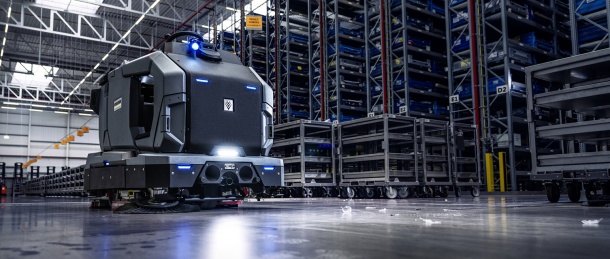
Today’s cleaning robots can map out rooms, detect objects and thoroughly clean all areas. But what are their limitations? And how are manufacturers addressing these? ECJ reports.
ROBOTIC CLEANING MACHINES have changed dramatically since they first hit the market. When autonomous machines appeared in the 1990s they were notorious for becoming stuck in corners, colliding with objects and neglecting to clean edges.
But modern robots have largely overcome their early limitations according to Kärcher’s robotics product manager Alina Seitter. “Basic obstacle avoidance was once a challenge, but today’s professional models can operate reliably even in high-traffic environments such as supermarkets and DIY stores without frequent interruptions,” she said.
“High-quality sensors are key to preventing collisions and handling cul-de-sacs. Our robots employ LiDAR laser scanners and 3D cameras to give them a 360-degree view and allow them to anticipate obstacles and dead-ends in advance and plan their paths accordingly.”
The market has been driven by labour shortages and demands for a higher cleaning quality, she says. “The focus has shifted towards robots that are easy to set up and that can handle a wide variety of environments from logistics warehouses to healthcare facilities,” said Seitter.
Today’s machines offer high levels of autonomy and building integration. “For example, docking stations allow robots to automatically empty dirty water, rinse their tank, refill with fresh water and charge their own lithium-Ion batteries,” she said. “Our robots can also interact with the building itself - for example, autonomously triggering high-speed roll-up gates to open. And modern mapping is rapid which means robots can autonomously calculate the most efficient path once a user has manually guided the machine once to capture the floor plan.”
The industry is moving toward a “cobotic” model where humans and machines work hand-in-hand, she said. “Robots take over the monotonous, time-consuming floor cleaning tasks which allows skilled staff to focus on higher-value ones,” she said. “This increases overall productivity and helps to address the current global staff shortages.”
Kärcher offers the KIRA B 50 autonomous scrubber dryer for use in medium to large areas and the KIRA B 200 for high-performance industrial cleaning. The KIRA CV 50 vacuum cleaner is designed for professional carpet and hard floor care.
Robert Scott’s robotics expert Peter Jones agrees that early cleaning robots regularly struggled with navigation. “Limited sensor technology meant that occurrences such as collisions with objects, becoming trapped in tight spaces and missing edges and corners were quite common,” he said.
Significant evolution
“While some entry-level or older models may still encounter these challenges, most modern commercial cleaning robots have evolved significantly.”
Today’s machines use advanced navigation and multiple sensors to map out their environment and recognise obstacles, he said. “They can then adjust their cleaning path dynamically. As a result, issues such as getting stuck or repeatedly missing areas are far less common.”
The most significant improvements have occurred through advances in sensor technology, mapping capability and software intelligence, according to Jones. “Many modern robots combine technologies such as 3D LiDAR, RGBD cameras and ultrasonic sensors to build a detailed map of their surroundings,” he said. “This allows them to plan efficient cleaning routes, avoid obstacles and operate safely in busy environments.
“And the increased computing power of today’s robots has improved their problem-solving ability, enabling them to re-calculate cleaning paths when faced with obstacles to effectively complete their tasks.”
Robert Scott robots combine intelligent navigation, automated charging and refilling plus remote management tools.
Issues such as getting stuck in corners, colliding with objects and failing to clean up to the edges of rooms were genuine limitations of early robots, admits Keenon marketing director Andy Zhou.
“These issues can still occur with less advanced systems, particularly in cluttered or constantly changing environments,” he said. “Corners and edges have always been a problem because robots need to balance cleaning precision with operational safety.”
Improved sensors, stronger navigation and smarter AI algorithms have made today’s robots better at understanding their surroundings and adjusting in real time, says Zhou. “Commercial users are no longer satisfied with a robot that can simply clean a fixed route - they want machines that work more intelligently, require less manual intervention and that can solve real operational pain points.”
Dry-wet separation has been a major robot breakthrough according to Zhou. “When dry debris and liquid waste are collected together, the tank can develop an unpleasant odour and become harder to clean,” he explained. “We have addressed this by introducing a triple-roller dry-wet separation system which keeps dry and wet waste streams apart while integrating sweeping, scrubbing and fast drying into one workflow.”
Another major development has been the self-cleaning station, he adds. “In the past, once the robot had finished cleaning a human had to empty the wastewater, dispose of debris and clean the machine. Today’s robots can return automatically to their self-cleaning station and complete these tasks on their own.”
One of Keenon’s key developments is AI Patrol Inspection. “By combining multi-sensor fusion with AI algorithms, the robot gains the ability to actively identify dirt rather than simply follow a pre-set route,” he said.
“Traditional robots usually patrol planned routes and there is no change in their behaviour when conditions alter. AI Patrol Inspection allows the robot to recognise common debris such as coffee spills, standing water or tissues, then automatically switch to the appropriate cleaning mode and calculate the shortest response path.”
Deeply integrated
Tomorrow’s robots are likely to become more adaptive, more autonomous and more deeply integrated into broader service systems, he believes. “They will not only clean more intelligently, they will also coordinate more effectively with digital platforms, management systems and other robots, creating a much more intelligent operational ecosystem,” he said.
Problems associated with early cleaning robots were typically linked to simplified sensing systems, constraints in edge-cleaning design and navigation algorithms that were less advanced than those of today, says BIB Robotics’ global product marketing manager Chris Chao.
“Collision risk is now reduced through a multi-sensor fusion system combining dual LiDAR and dual TOF cameras and supported by AI-based semantic obstacle avoidance,” he said. “This enables full 360-degree environmental awareness and adaptive path planning in dynamic spaces.”
For edge and corner coverage, dedicated cleaning algorithms combined with wall-following and right-angle corner modes improve reach in boundary areas, he adds. “Our J series of commercial cleaning robots were developed to address those long-standing industry challenges.”
New from BIB Robotics is the J36 which is designed for use in small-to-medium indoor commercial environments such as retail stores, offices, hotels and healthcare facilities. The machine is said to offer precision mapping, AI-based path-planning and intelligent obstacle avoidance.
Early robots relied on simple collision sensors and used random navigation patterns, says Hako’s cleaning technology project manager Nils Rottmann. “They struggled in highly dynamic environments and had issues with moving obstacles, glass surfaces and complex layouts,” he explained. “Modern commercial robots use multi-layered sensor systems along with precise mapping and
navigation methods. There are still some cases where user interaction is required, though the frequency of such events has decreased considerably.”
Modern systems detect their surroundings precisely using laser scanners, cameras and ultrasonic or ToF sensors, he said. “This allows them to identify obstacles at an early stage and adjust their route accordingly,” says Rottmann. “They then create a digital map of the area and plan their driving paths systematically instead of moving randomly through the space.”
The brushes and working units of today’s machines are positioned in such a way that edge areas are reached more effectively and fewer ‘dead zones’ occur, he adds. “Overall this combination of improved environmental detection, intelligent navigation and optimised cleaning technology means that collisions, dead ends and uncleaned edges are now far less common.”
Development has gained significant momentum over the past five to seven years, according to Rottmann. “Manufacturers are investing heavily in developing their systems due to cost pressures in facility management and a growing shortage of skilled labour,” he said. “In addition to navigation the main focus today is on software, connectivity and fleet management. Customers expect not only autonomous cleaning but also transparent processes, available operational data and measurable efficiency improvements.”
The latest robot capabilities include autonomous docking and charging; automatic filling and emptying and precise, site-specific mapping, he said. “Systems with ‘legs’ for climbing stairs exist in research environments, but are currently neither economically nor technically relevant for commercial floor cleaning.”
Intelligent adjustment
Manufacturers are continuously working to make robots even more capable, he adds. “This includes coming up with better systems for environmental detection, intelligent adjustment of driving and cleaning routes, more precise edge guidance and automated quality control,” he said. “And a stronger integration with building management systems will make processes more efficient.”
Hako’s Scrubmaster B20 i and Scrubmaster B75 I can automatically charge, refill and empty its water tanks via the docking station. The Scrubmaster B20 i for small to medium-sized spaces uses
water and chemicals economically and can be operated manually when required. The Scrubmaster B75 i for larger areas has a simple operation via touch display and offers fully automatic charging and water-handling.
So, is there anything that a robot is still unable to do?
Narrow and highly complex environments remain an issue for robots, says Rottmann. “They also struggle when carrying out detailed tasks such as cleaning along skirting boards or under low fixtures,” he said. “And they cannot react as flexibly as a human to unexpected issues such as a larger liquid spill.”
Environments that have significantly changed often need re-mapping before the robot can work optimally again, he adds. “A combination approach works well in practice: the robot handles large open areas and recurring cleaning tasks while humans take care of detailed work, unexpected issues and inspections. This allows efficiency and cleaning quality to be combined effectively.”
Robots work less effectively when carrying out highly detailed, irregular or judgment-heavy tasks, says Keenon’s Andy Zhou. “Tight corners, unusual layouts, sudden non-standard messes and deep-cleaning requirements can still require human intervention,” he says.
Human intervention
Kärcher’s Alina Seitter agrees that robots still have limitations as far as specialised tasks are concerned. “They are primarily designed for systematic, large-area floor cleaning rather than ad-hoc crisis response or detailed work on complex surfaces,” she said “Human teams are still enlisted to handle more intricate tasks such as sanitising high-touch points.”
BIB Robotics’ Chris Chao says robots still have reduced accessibility in extremely narrow or irregular spaces. “They also offer limited performance when handling stubborn stains and emergency cleaning situations,” he adds. “Ongoing improvements are required in system robustness under extreme conditions.”
And Robert Scott’s Peter Jones adds that robots are not designed to entirely replace human cleaners despite their growing levels of sophistication. “Challenges can still arise in highly cluttered environments or where detailed cleaning is required such as tight corners, on stairs and vertical surfaces,” he said. “Robots are now sweeping up to the edges of walls but are not yet delivering deep cleans in this area.
“Robotic cleaning is therefore often most successful as part of a hybrid approach, where robots handle routine floor cleaning while staff focus on more detailed or responsive tasks.”





 RSS
RSS