



Home › magazine › february march 2026 › latest news › Sensory scrubbing

Sensory scrubbing
13th of March 2026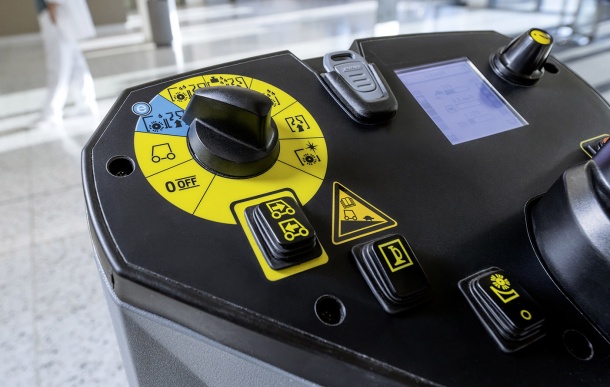
How important are the look, sound and feel of a scrubber dryer compared with other factors such as size, cost and productivity? Ann Laffeaty finds out to what extent the senses play a part in the customer’s choice of machine.
A scrubber dryer has a purely functional role. It simply needs to be able to clean and dry a floor thoroughly so that it is ready for a quick re-use.
But what impression would a grubby, noisy or boxy-looking machine have on the visitor? Would he/she be less likely to have confidence in the cleaning ethos of a facility where the scrubber dryer in use presented an unprofessional appearance? And would the cleaner be less excited about using a machine that is uncomfortable to operate or unprepossessing to look at?
The appearance of a scrubber dryer plays a bigger role in the decision-making process than many people might expect, according to LionsBot branding and marketing manager Sherilyn Quek.
“Our customers see cleaning robots not just as tools, but as part of the brand experience,” she said. “A smart, attractive machine reflects the values of a clean, modern and forward-thinking venue.”
Low noise levels contribute to a more pleasant experience both for the user and for the general public, says Quek. “Many of our robots clean in high-traffic environments such as malls, airports and offices so we engineer our machines to run quietly,” she said. “This means they can operate during the day or night without disruption.”
A scrubber dryer also needs to be easy to use with ergonomic controls, she adds. “Cleaners come from many diverse backgrounds which means an intuitive operation is key.”
All LionsBot autonomous models feature a large touchscreen interface, a one-touch start button and ergonomic handlebars. The LionsBot R3 Scrub Pro is said to combine a compact, elegant
design with low noise levels and a smooth motion. And it is designed to blend into any public space from premium offices to hospitals.
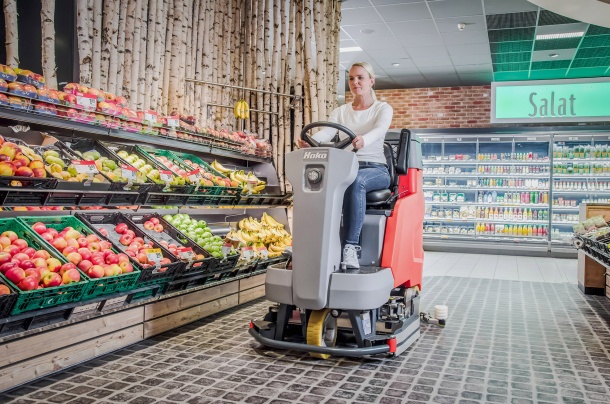
Appearance is particularly important for scrubber dryers in public areas such as shopping centres, airports and hospitals believes Hako application technology trainer and consultant Klaus Serfezi.
“A well-maintained and modern-looking machine will contribute to a positive overall impression of the facility,” he said. “It also reflects the image of the service provider. If the cleaning equipment itself is not clean, how can the job be successful? The interplay of high functionality and a clean appearance is a key combination.”
Quiet operation
An unobtrusive design is important in many areas of application and during daytime cleaning in particular. “Subtle colours, a compact design and clean lines will help the machine blend harmoniously into its surroundings without attracting attention,” said Serfezi.
A quiet operation is an essential aspect of modern cleaning technology, he adds. “This is particularly so in sensitive areas such as hotels, clinics, schools and office buildings,” he said. “Here a low noise level allows cleaning to be carried out during operating hours without disturbing people. For this reason, machines are increasingly being designed with low-noise drive technologies and optimised sound insulation measures.”
A scrubber dryer needs to be easy to operate with a comfortable seat and ergonomic controls, he says. “An intuitive operation, a good overview of the working area, adjustable seats and logically-arranged controls will all contribute to safety and efficiency at work. In most cases, large ride-on machines operate in the workplace for an entire working day. An ergonomic design therefore helps to reduce fatigue and operating errors.”
According to Serfezi, factors such as ease of use, ergonomics and low noise levels are all key considerations during machine development. Hako scrubber dryers can be equipped with a silent mode which reduces the speed of the suction motor in noise-sensitive areas such as hospitals and retirement homes, while the single-button operation allows new users to quickly learn how to use the machine.
CEO of Dryft World Imre Killi believes it is becoming increasingly important for cleaning equipment to look good. “The industry has traditionally been dominated by large, bulky machines where aesthetics were an afterthought,” he said. “But expectations are changing.
“Imagine walking into a prestigious venue such as a luxury hotel, a flagship retail space or a high-end office where every detail has been carefully considered to reflect the brand’s values. And then you notice an operator cleaning the floors with an old, clunky machine. It disrupts the image and speaks volumes about the organisation’s priorities. Does the business cut corners on quality? Is it clinging to outdated methods?
Sleek and modern
“Where the opposite is the case - where a sleek, modern, agile machine that complements the space is being used instead - this highlights the fact that the business cares about every detail including how it is being maintained. The equipment then becomes part of the brand story and
bears visual proof of a company that values innovation, cleanliness and pride in presentation.”
The ideal machine should be unobtrusive and blend into the background, Killi adds. “The cleaning equipment a business chooses is a reflection of its core values whether that means innovation, efficiency or simply pride in maintaining high standards,” he said. “In a world where impressions matter even those behind-the-scenes decisions speak loudly. Cleanliness should never feel like an afterthought - and neither should the tools used to achieve it.”
While floor cleaning machines in an ideal world would be completely silent, this is not yet possible according to Killi. “There is often a trade-off between compactness, performance and acoustics as cleaning technology evolves,” he said. “For example, making machines that are lighter and smaller can reduce noise insulation simply because there is less material to contain the sound.”
The ‘feel’ of the machine when in operation should always be a major consideration, he adds. “One of the biggest design challenges is making a scrubber dryer that is truly intuitive so that anyone can operate it confidently regardless of experience,” he said.
“It is common for multiple operators to use the same piece of equipment across different shifts or locations which makes consistent training a challenge. And reliance on complex instructions can lead to misuse, inefficiency or even damage. So when a product is designed to be intuitive in use it reduces errors, increases productivity and makes life easier for the people who rely on it every day.”
Dryft World’s Dryft machine is said to be comfortable, quiet and visually attractive with a sleek, modern look. Its vertical S-handle is fitted with a soft rubber grip and is claimed to promote a more ergonomic and natural movement.
The appearance of a professional scrubber dryer holds significant importance for business-to-business customers, says Karcher’s vice president of floor care solutions Christian Mrowka.
“While the primary purchasing decision hinges on performance, reliability and total cost of ownership the machine’s design and aesthetic are increasingly relevant,” he said.
“A machine with a modern, professional and visually-appealing design reflects positively on the brand values of a venue, particularly in highly visible areas such as shopping centres, airports and hospitals. The cleaning process and the equipment used in these public-facing environments will contribute to the perception of professionalism, hygiene and operational quality.”
Seamlessly integrate
The ideal machine should be both aesthetically pleasing and unobtrusive, he said. “The design should be functional, modern and easily identifiable as a high-quality piece of equipment,” he said. “However, in environments where cleaning needs to occur during operating hours the machine’s design should allow it to seamlessly integrate without causing visual disturbance.”
Low noise operation is a key factor in machine development at Kärcher, he said. “As cleaning schedules increasingly shift to daytime hours to improve efficiency and supervision, minimising disturbance to public, patients and employees is critical,” said Mrowka. “High noise levels not only interrupt activities in the venue but also contribute to operator fatigue and can exceed occupational noise limits.”
Kärcher’s eco!efficiency mode is designed to significantly reduce noise levels in sensitive areas such as hospitals, hotels, and office buildings. The company also incorporates efficient suction designs
into its development process to stifle sound at its source while maintaining maximum performance.
A professional scrubber dryer needs to be easy to use with a focus on operator comfort and ergonomic controls, Mrowka believes. “The operator is central to productivity which means ergonomic design is not merely a comfort feature but a direct driver of efficiency, reduced fatigue and a decreased risk of injury,” he said.
“Prioritising ergonomics ensures consistent high-quality cleaning, reduces errors and minimises downtime due to operator discomfort or training complexity,” said Mrowka. “With an ageing workforce and a diverse demographic that frequently includes smaller-statured operators, ergonomics in scrubber dryers have become a critical factor. Modern equipment must offer intuitive, highly adjustable handling to ensure long-term health and peak efficiency for every user, regardless of their physical build or age.”
So, how important are sensory factors for customers when making their decision to buy?
Practicality and return on investment tend to lead the conversation according to LionsBot’s Sherilyn Quek. “However factors such as the sound, appearance and even the way the robot ‘feels’ in use often seal the deal,” she adds. “Customers want a machine that projects quality and reliability and that their teams enjoy working with.”
Operator feedback
Most customers use rational criteria such as area output, reliability, ease of maintenance and total cost of ownership when making their purchasing decision, says Hako’s Klaus Serfezi. “However, sensory impressions such as noise, design or feel can play a complementary role, particularly if the machine is regularly used within sight or earshot of customers or visitors,” he said.
Operator feedback is often an underestimated factor in the decision-making process, according to Dryft World’s Imrie Killi. “If the team doesn’t like it, they won’t use it and the machine will languish in a storage room while cleaners revert back to mops because the new tool was too complex, too heavy or simply unpopular,” he said. “Investing in equipment that staff won’t use is a costly mistake.”
Kärcher’s Christian Mrowka holds a different view. “The purchasing process is a logical, business-driven decision where the lowest total cost of ownership over the machine’s lifecycle will be prioritised,” he said. “A machine that is aesthetically pleasing, quiet and comfortable will therefore only succeed if it also delivers superior cleaning results, minimal operational costs and a high level of durability.”





 RSS
RSS