



Home › magazine › november 2025 › latest news › High pressure cleaning elevating standards

High-pressure cleaning - elevating standards
13th of January 2026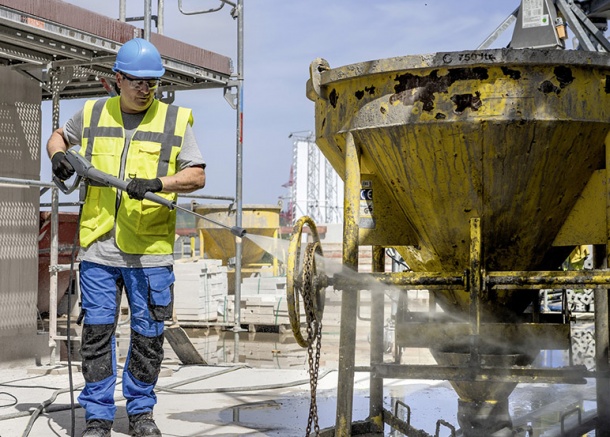
Heading up this special report on high-pressure cleaning is R+M de Wit’s Dirk Niesen. He explains how today’s industry is driven by a blend of engineering, chemistry and digital technology.
As an essential pillar of modern maintenance and hygiene across Europe, the professional high-pressure cleaning sector continues its rapid evolution. The days of rudimentary water blasting are long past. Today, the industry is driven by a sophisticated blend of engineering, chemistry, and digital technology, focusing intensely on four core imperatives: efficiency, ergonomics, mobility, and sustainability.
The primary objective has remained constant: to maximise cleaning power while simultaneously reducing operator effort and minimising operational costs. In recent years, this focus has yielded significant, practical advancements that directly impact the daily routines of professionals.
Ergonomics and efficiency
Recent engineering efforts have focused heavily on usability and resource optimisation. Core advancements directly enhance daily workflow:
• Ergonomics: Innovations like quick-connect systems allow for accessory changes up to five times faster without compromising seal integrity. Similarly, new ergonomic high-pressure guns have reduced trigger and holding forces to near zero, enabling fatigue-free operation over extended periods. Enhanced mobility features, such as optimised centres of gravity and large wheels, simplify transport and on-site manoeuvrability.
• Performance and consumption: Cleaning power is optimised through resource-saving technology. Hot-water units leverage thermal energy to dissolve oils and stubborn grime, resulting in shorter cleaning times, reduced chemical use and a vital sanitising effect for the food and agricultural sectors. The shift to foam cleaning significantly extends detergent contact time on vertical surfaces, loosening dirt before mechanical action, thus lowering required pressure and protecting the substrate. And optimised components - from pumps, valves, accessories to nozzles - have minimised flow and pressure losses, driving overall energy efficiency.
These advancements have secured the high-pressure cleaner’s role in traditional applications, including vehicle cleaning, surface maintenance, industrial equipment sanitation and municipal services.
Evolving application fields
Today’s dynamic growth areas demand a more nuanced approach, pushing cleaning providers into specialised fields like façade, roof, and solar/photovoltaic. These areas present vastly different challenges in terms of water pressure, temperature and accessory requirements, due to the varied sensitivity and contamination types of the surfaces.
• Solar cleaning: This is the most sensitive application. Really high pressure is avoided to prevent damage to glass and seals. Cleaning relies on demineralised water and gentle mechanical action, often via rotating disc brushes with nylon bristles, often mounted on telescopic poles and driven by the water flow, to ensure a spot-free, scratch-free finish.
• Roof cleaning: The goal is the removal of deeply rooted biomass, such as moss and lichens, which necessitates high pressure. The critical safety element is the working direction (always top-to-bottom) to prevent water from being forced under roof tiles and damaging the sub-structure. Hot-water units are often deployed for effective removal of stubborn growth and for thermal sanitation. Accessories include powerful rotation nozzles and, for robust roof tiles, specialised self-propelled roof cleaning devices.
• Façade cleaning: This is the most adaptive application, where pressure must be precisely matched to the material. A robust clinker brick façade can withstand high pressure, while a rendered façade must be cleaned using extremely gentle pressure to avoid roughening the material or forcing moisture into the insulation.
In all these scenarios, pre-foaming the surface with detergent has become an indispensable best practice. The stable foam adheres longer - even to vertical surfaces - extending the crucial contact time of the chemical agents (Time + Chemistry in Sinner’s Circle). This effectively loosens tenacious contamination, reducing the need for aggressive mechanical force (Mechanics + Pressure). The result is faster, safer cleaning with a lower risk of material damage.
Drone-based cleaning
The reduction in necessary mechanics and pressure, made possible by pre-foaming, has paved the way for a revolutionary application method: cleaning drones. The deployment of cleaning drones combined with high-pressure or medium-pressure spraying systems is fundamentally transforming roof, façade and solar cleaning, primarily through a dramatic increase in safety and enhanced cost-efficiency. This technology enables professional providers to maintain high and difficult-to-access areas faster, more precisely and without costly scaffolding or lifting infrastructure.
The ultimate advantage of drone cleaning is safety and risk mitigation:
• Elimination of work at height: The single largest risk in roof and façade cleaning is the fall hazard. By operating the drones remotely, personnel can remain safely on the ground. The risk of high-altitude accidents is virtually eliminated.
• No access to sensitive surfaces: In roof and solar cleaning, there is no need to step onto the structure. This minimises the risk of damage to fragile roof tiles, seals or sensitive solar glass caused by the weight of workers or scaffolding.
Drone systems also accelerate the cleaning process and significantly boost cost and time efficiency:
• Elimination of expensive infrastructure: The need for scaffolding, cherry pickers, or industrial rope access is either removed or substantially reduced. This cuts the overall cost of a cleaning operation dramatically (in some cases by 50–80 per cent) and saves the time-intensive logistics of setup and dismantling.
• Faster area coverage: Modern drone systems achieve high area output for both the foaming stage and subsequent rinsing, making the work substantially faster than conventional methods.
• Minimal operational disruption: With no blocked entrances and no weeks-long scaffolding construction, the disturbance is minimal.
Specialised accessories for drone operation: The drone can perform the chemical pre-soaking (low-pressure) and the subsequent high-pressure rinse sequentially without personnel having to ascend. The cleaning agent is metered into the high-pressure water stream on the ground, downstream of the pump, and then foamed using a foam nozzle mounted on the drone.
• The crucial role of the foam nozzle: The foam consistency is critical. It must be engineered to ensure a sufficient throw distance, counteracting varying wind conditions, while also ensuring the foam adheres to the target surface long enough to achieve the necessary contact time for the chemical to penetrate the soiling.
• Rotary nozzles for high-pressure rinsing: The subsequent high-pressure rinse is carried out using rotary nozzles specifically designed for drone applications. Unlike flat-jet nozzles, rotary nozzles offer advantages in uniform surface cleaning due to their jet geometry, which is especially beneficial for non-flat surfaces.
• Weight and performance requirements: These rotary nozzles must be as light as possible to minimise the drone’s take-off weight, thereby maximising flight time. For safe and effective cleaning, a large droplet size is also essential. This ensures sufficient impact energy at a greater throw distance without providing enough force to damage the substrate.
The use of drones in professional cleaning is, therefore, a clear and decisive trend that significantly enhances efficiency, cost-effectiveness and occupational safety across the board.
Sustainability and conclusion
Environmental responsibility is no longer optional. Modern high-pressure cleaning is inherently water-saving compared to traditional hosing. While chemicals are sometimes necessary, their use is minimised, especially through the effectiveness of hot water and foaming pre-treatment.
The most critical environmental factor is managing the resulting contaminated effluent. Best practice dictates the collection and proper disposal or recycling of the dirty water and particulates. Advanced service vehicles are now equipped with on-site water reclamation systems to filter and reuse the water, setting a new benchmark for resource-conscious operation.
So the current state of professional high-pressure cleaning technology is transforming equipment into tools that are more powerful, comfortable and resource-efficient. Through a combination of refined ergonomics, advanced thermal and chemical pre-treatment, and revolutionary deployment methods like drone technology, it has evolved from a simple power tool into an intelligent, versatile and essential asset that significantly simplifies and elevates the operational standards of the cleaning professional. Maximum performance delivered with minimum impact.




 RSS
RSS