




Home › magazine › november 2025 › latest news › A trolley for all trades

A trolley for all trades
14th of January 2026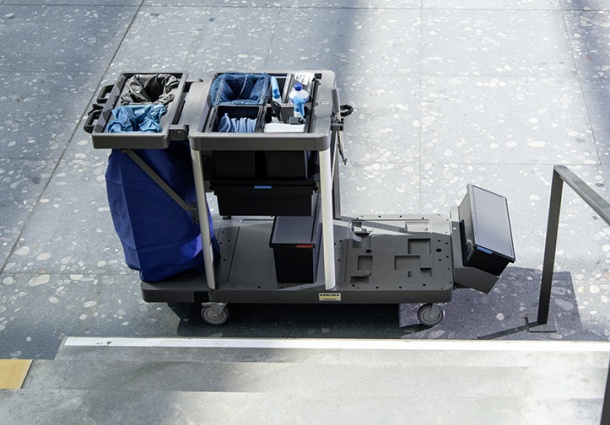
How does a trolley need to be configured for use in a school, an office, a hospital or a hotel? Ann Laffeaty looks at the different requirements for trolleys in a range of environments and asks companies how they should be adapted for each.
A CLEANING TROLLEY is simply a vehicle for transporting cloths, mops and detergents to the site where they need to be used. So one could be forgiven for assuming that all trolleys are basically the same.
But this is not the case. A cleaning trolley for use in the healthcare sector - where hygiene and safety are paramount - needs to have a very different profile to that, say, of a hotel trolley.
Healthcare trolleys need to be easy to clean and should incorporate lockable sections plus compartments where contaminated cleaning cloths may be stored, for example. A hotel trolley, on the other hand, must be discreet and unobtrusive while also being able to accommodate items such as linen and toiletries alongside cleaning products.
And different requirements will apply in an office, where the bins need to be emptied and carpets may need to be vacuumed, and a school which will no doubt feature large expanses of hard flooring.
So how should a trolley be adapted for use in each different environment? And what are the basic elements required in every case?
Hygiene priorities
Hygiene and infection prevention are the top priorities in healthcare, says Kärcher’s manual tools product manager Jennifer Majcher. “Healthcare trolleys need to have an easy-to-clean chassis along with smooth, non-porous surfaces that are resistant to disinfectants,” she said. “They should also be designed with minimal curvature to avoid a build-up of dirt.
“A quiet operation and low-noise wheels are other important features here to avoid disturbing patients, while an ergonomic design will reduce the strain on staff who may have to work long, demanding shifts. And lockable compartments will be required to prevent any unauthorised access to cleaning chemicals and equipment.”
Cleaning trolleys in hotels need to combine efficiency and discretion with aesthetics, she said. “Essential features here will include quiet wheels and smooth handling to avoid disturbing guests plus a compact and narrow body that will easily fit into lifts and move through narrow corridors,” said Majcher.
“Ample amounts of organised storage space will be required for supplies of fresh linen, towels, toiletries and cleaning products, with all compartments designed to provide quick access. And these should have doors to create a tidy, closed look while the trolley itself should have a clean, professional design to blend in with the hotel environment and maintain a pleasant guest experience.”
Specially adapted
Versatility and space-efficiency are crucial in an office environment, she says. “Offices usually combine hard floors with carpets so the trolley should have the capacity to carry vacuums and mopping systems to cater for both,” she said. “Manual tools will be needed for desks and shared areas while separate bins for waste and recycling are often also necessary, since offices generate various types of rubbish and recyclables.
“And a smaller, more manoeuvrable trolley is essential here because many offices have limited storage space and tight working areas. This also means that all drawers and compartments should Ideally be accessible from both sides.”
Other environments that require specially-adapted trolleys include schools, airports, shopping centres and transport vehicles, she said. “Schools need to have a high waste management capacity plus sufficient mop storage for extensive floor cleaning, which will often need to be supplemented by machines,” she said.
“Shopping centres and airports are both high-traffic areas which means trolleys here should be discreet and manoeuvrable with lockable compartments and high waste management capabilities. And compact models equipped with both wet and dry floor cleaning tools are required for transport vehicles such as trains since these will enable an efficient operation in restricted environments.”
Kärcher’s modular FlexoMate series is designed to be able to adapt to different environments. FlexoMate trolleys can be upgraded or downsized while components such as buckets, bins, tool holders and drawers may be added or swapped. The FlexoMate ExpertPro is said to be a good fit for healthcare since it features lockable compartments, while the FlexoMate Expert offers additional storage for manual cleaning equipment. And the FlexoMate Swift is described as being compact, easy to store and particularly suitable for use in tight spaces.
Maximising safety is a key priority in the healthcare sector, says Filmop’s business development manager Paolo Scapinello.
Safety is key
“There needs to be strict control over the use of detergents, work tools and sensitive materials,” he said. “Trolleys, mop holders and other items used in healthcare should also be treated with anti-bacterial additives to protect them against bacteria, fungi and moulds.
“For office cleaning, small trolleys that are easy to move around easily will be required. These should be sufficiently compact to allow them to pass easily between desks and cabinets and through even the narrowest of corridors. Another feature to consider here is an efficient waste collection section.”
Educational facilities have particularly complex requirements, according to Scapinello. “These are made up of several different environments, each with its own specific features and needs,” he said. “The classrooms, offices, corridors, canteens and washrooms each require a targeted approach along with equipment capable of adequately responding to their needs.”
Filmop’s Alpha trolley can be configured in multiple ways for use in various environments, he said. It can offer dividers for separate waste collection for use in offices as well as a washing area with top-down buckets where cloths and mops can be pre-soaked for educational establishments. And for healthcare facilities, the company’s trolleys feature anti-bacterial additives and also have a new automatic locking system to provide control over detergents, work tools and sensitive materials. The locked compartments may be opened by authorised personnel only by means of a universal key which can be stored inside a special compartment integrated into the trolley.
Healthcare trolleys need to be configured in such a way as to avert the risk of cross-contamination and minimise the spread of viruses and bacteria, says TTS Cleaning’s export sales manager Alessandro Costantini.
“There needs to be a clear division between the area for soaking clean mops and the area for collecting used mops,” he said. “This will ensure that the dirt will be confined to the collection area, reducing the risk of cross-contamination and protecting both the patients and healthcare personnel.”
Trolleys used in the hospitality sector need to offer maximum functionality, efficiency and discretion, he said. “All equipment here must not only ensure high performance but also promote a professional image and blend into the environment,” said Costantini.
TTS offers modular trolleys that may be customised with the aid of various components and accessories. For the healthcare sector, the company’s Magic trolleys can be equipped with the Dosely soaking station and the Dosely and Pockety touch-free disposing system to optimise hygiene while avoiding any hand contact with dirty mops.The company also offers MagicArt trolleys for the hospitality sector which can be used for transporting mini-bar supplies along with crockery, cutlery and towels. And Dust Titan trolleys are said to offer a high capacity to facilitate linen collection.
But what are the essentials of any trolley, whatever their environment? Ergonomics, durability and modularity are fundamental requirements everywhere, says Kärcher’s Jennifer Majcher.
Essential features
“Every trolley should be built from robust, high-quality materials and minimise operator strain while also offering plenty of storage space,” she said. “The ability to add, remove and reconfigure components is another major advantage because this will allow the trolley to be customised for specific jobs and increase its versatility. And since a trolley is a long-term investment it must be built to withstand daily use in demanding environments.”
A modular design, robust construction and smooth-running wheels for optimum manoeuvrability are all essential features, according to Filmop’s Paolo Scapinello. “Ease of cleaning is another aspect to consider, while a clear separation of the washing, storage and collection areas will prevent any potential cross-contamination between zones,” he said. “And all trolleys should be sustainable.”
TTS’s Alessandro Costantini says modularity is essential in any trolley. “All components should be customisable according to the specific washing, storage and waste collection needs of the environment,” he said. “There should also be a wide range of accessories available designed to facilitate different operations. A trolley that is custom-made will allow you to perform the various operations more quickly, thus reducing the overall cost.”





 RSS
RSS