



Home › magazine › april may 2026 › latest news › Shiny happy people

Shiny happy people
29th of May 2026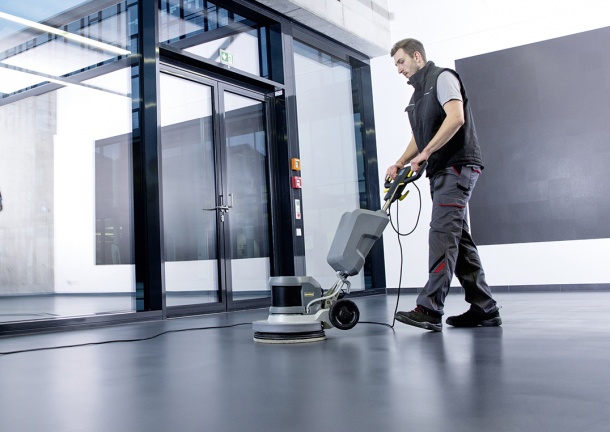
A floor polishing system needs to be ergonomic, safe and user-friendly if the operator is going to be happy using it. Ann Laffeaty talks to manufacturers and contract cleaning companies about the types of floor polishing systems where user-friendliness is placed front and centre.
A good floor polishing system needs to be able to create a long-lasting shine as quickly and as economically as possible. But it also needs to ensure the health and safety of the operator. Heavy equipment, trailing cables, poorly-positioned handles, chemical-based floor polishes – all of these could represent a risk to the person tasked with working on the floor.
Any system employed should be easy to operate because staff members who are uncomfortable or unhappy using it will inevitably be less productive. And if the machinery supplied is cumbersome or if the controls are non-intuitive they may seek to avoid using it altogether.
So, how do companies ensure their floor polishing systems and products are ergonomic, user-friendly and safe to use for the operator? And how important are ergonomics in the development of a floor polishing system anyway?
The potential health and safety risks involved when polishing a floor need to be carefully managed, according to Cleanology’s environmental, social and governance director Kate Lovell. “The surface can become extremely slippery during the floor polishing process and this will increase the likelihood of slips and falls,” she said. “Trailing power cables will also create an additional trip hazard and the equipment involved can place a strain on the body.”
She says floor polishing machinery can often be heavy to use and require the operator to execute a series of controlled, repetitive movements. “These can lead to muscle strains in the back, shoulders and arms,” said Lovell. “Also, moving or transporting machinery without adherence to proper manual handling protocols can further increase the risk of injury.”
Reducing the risks involved in polishing a commercial floor requires a combination of the right equipment, effective training and safe working practices, she says. “Operators should receive thorough training on how to handle machinery safely and this should include maintaining the correct posture, machine control and manual-handling techniques to minimise strain,” she said. “Using lighter or ergonomically-designed equipment can further reduce the risk of injuries.”
Respiratory risks can be controlled by ensuring there is a good level of ventilation in the working area, she adds. “Suitable respiratory protection should be provided where necessary to guard against dust or fumes released during the polishing or preparation stages,” she said. “And operators should use clear signage to warn others of areas that are wet or polished while also ensuring an adequate drying time for floors to prevent slips.”
Floor polishing can be carried out safely by using the appropriate equipment, employing a good technique and ensuring there are well managed working conditions, said Lovell. “Accidents and slips can be prevented by keeping the work area clearly marked and by ensuring that only small sections of the floor are polished at a time so that operators always know which areas are slippery,” she said.
“Adequate drying time should be allowed and good lighting should be maintained to help reduce the risk of slips and falls. And any trailing cables should be routed safely along walls or secured to prevent tripping.”
Injuries can also be avoided by giving operators proper training on how to handle polishing machines, she adds. “Choosing well maintained, ergonomically-designed machines with adjustable handles will reduce the strain on the operative,” she said. “Taking regular breaks can also prevent fatigue.”
All Cleanology operatives receive training on machine handling, safe working postures, chemical use and ways of identifying slip and trip hazards, says Lovell. The company also carries out inspections at each customer site before beginning work. And it emphasises the importance of staff members inspecting their equipment for cable damage, loose components, worn pads or any electrical issues.
Polishing and floor finishing routines can require long and repetitive working cycles, says Filmop’s business development manager Paolo Scapinello.
“If the working pattern is not natural, operators tend to compensate by loading the wrist, shoulder and lower back which increases fatigue and raises the likelihood of musculoskeletal discomfort over time,” he said. “So the main health and safety risks we address at Filmop relate to repetitive movements, operator fatigue and maintaining control during manual floor care tasks in commercial environments.”
Physical load
The choice of textile can also have an influence on both effort and control, he said. “When a mop drags, saturates quickly or releases moisture unevenly the operator will typically apply extra pressure and need to make repeat passes,” he said. “This will increase the physical load and make the process less consistent.”
Choosing systems that are both efficient and ergonomic to use is important – but is not enough on its own, says Scapinello. “The biggest reduction in risk comes when the equipment and methodology work together, and this relies on training and consistent routines,” he said.
Training needs to start with the correct tool set-up, he said. “Operators need to learn how to adjust the handle height of any equipment so that it matches both their body and the task in hand,” he said. “They must also understand how to use a controlled S-shaped movement rather than forcing the wrist or overreaching with the shoulder.
“These small corrections in their daily technique will make a major difference over the operative’s long, repetitive shifts and becomes one of the most effective ways of preventing musculoskeletal discomfort.”
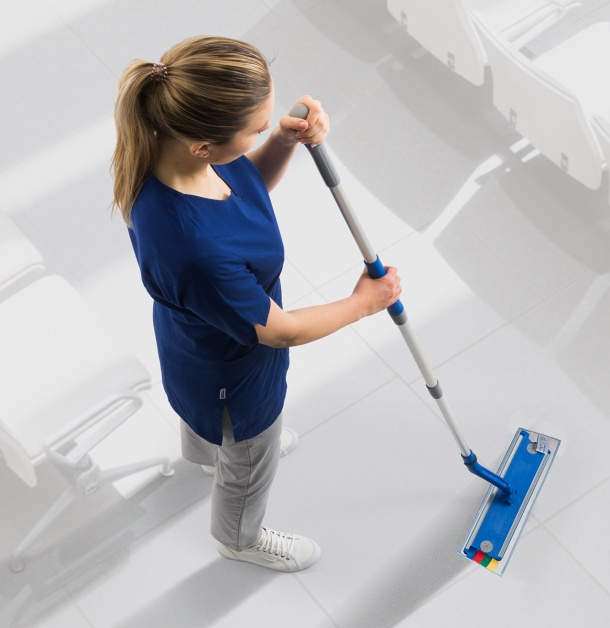
Filmop’s Ergoswing system may be used for dry polishing and for applying maintenance waxes to floors. It consists of a telescopic handle with turning grip and a mop holder with an ergonomic joint designed for an easier ‘S’ movement. The system is said to enable the operator to maintain the correct posture while working, helping to reduce strain and improve productivity.
Physical strain and environmental factors pose the primary risks to the operator during floor polishing applications, says Kärcher’s vice president of floor care solutions Christian Mrowka.
Mitigate risks
“Operators are frequently exposed to vibrations and prolonged muscle tension due to the torque of high-speed machines,” he said. “Additionally there is a risk of respiratory issues if the dust generated during dry polishing is not effectively contained. And tripping hazards from cables in corded models and slips caused by the improper application of polishing agents represent significant safety concerns in commercial environments.”
A combination of technical equipment and organisational measures can help to mitigate the risks, he says.“All machines should have low vibration values as well as integrated dust suction systems to protect the operator’s respiratory health,” said Mrowka. “Regular operator training to cover posture and guiding techniques should also be provided along with personal protective equipment such as non-slip footwear. And managers should ensure there is adequate ventilation in confined spaces in order to maintain high safety standards.”
Accidents and slips may be prevented by clearly marking the work area and ensuring that all chemical polishing agents are dosed precisely via integrated dosing systems, he said. This will avoid the issue of any excess residue on the floor surface, he adds. Kärcher offers a range of ergonomic floor polishing machines said to be easy to handle such as the single-disc BDS 43/DUO C and the ultra-high-speed BDP 50/1500 C which has a central auxiliary impeller, an adjustable handle and a rotating guard to prevent dust from swirling around.
New stripping agents, pads, floor machines and floor finishes are frequently being launched to improve productivity, performance, ergonomics and comfort, according to Mrowka.
“Selecting the correct polishing method whether it is a machine, accessories or chemicals will ensure great results along with a high degree of productivity and comfort,” he said. “There is no need to use big, heavy machinery to achieve the best possible cleaning result: great results can be gained with the aid of light and ergonomic machines by combining them with the correct accessories and chemicals that will deliver a superior result in less time and with higher comfort.”
Kärcher uses ergonomic simulations when designing handles and control elements in a bid to minimise physical load, claims Mrowka. Safety features such as automatic motor-stop functions when the handle is released and adjustable contact pressure are also integrated from the initial design phase. “Our goal is to ensure that the machine adapts to the user - and not vice versa - in order to prevent long-term occupational health issues,” he said.
While operator safety is clearly important, how far is it considered in the development of any floor polishing systems?
Ergonomics and operator safety are major considerations in the design of any modern floor polishing equipment, says Cleanology’s Kate Lovell. “Manufacturers focus on features such as adjustable handles, lightweight materials and reduced vibration to minimise strain and improve comfort during use,” she said. “But customers also expect machines to be efficient, durable and cost effective. So the most successful products are those that strike a balance between strong safety credentials, high productivity and long term affordability.”
Driving productivity
Ergonomics and operator safety are closely connected with other considerations such as productivity and cost, according to Filmop’s Paolo Scapinello. “When a cleaning system reduces fatigue it allows operators to maintain a steady pace and work more accurately for longer,” he said. “And that reduces the likelihood of mistakes along with the need for reworking.”
Like Scapinello, Kärcher’s Christian Mrowka says safety and productivity are not mutually exclusive. “In fact, ergonomics is a driver of productivity,” he said. “An operator who experiences less fatigue and works with equipment that is both intuitive and safe is more efficient and less prone to errors or absences due to injury.”





 RSS
RSS